Which budget-friendly tracker gives you the better battery life, brighter display and real-world value — Samsung’s sleek Galaxy Fit 3 or the feature-packed Smart Band 8?
Concise comparison of the XIAOMI Smart Band 8 (Global) and the SAMSUNG Galaxy Fit 3, examining battery life, display quality, fitness tracking accuracy, software experience, and overall value to help Amazon shoppers decide which affordable wearable fits their needs today.
A compelling budget fitness band that balances battery life, a bright display and useful health tracking. It delivers excellent value for everyday users who want a capable tracker without a high price tag.
A polished fitness tracker that prioritizes display quality and long battery life while adding refined sleep and health features. It’s a solid mid-range choice for users who want a feature-rich tracker with a premium feel without stepping up to a full smartwatch.
Xiaomi Band 8
Battery life
8.5
Display quality
8
Fitness & health tracking
8
Build & comfort
8.5
Value for money
9
Galaxy Fit 3
Battery life
9
Display quality
9
Fitness & health tracking
8.5
Build & comfort
8
Value for money
8
Xiaomi Band 8
Pros
Long battery life for everyday use
Large, clear 1.62″ AMOLED display
Strong value with robust fitness features
Lightweight and comfortable for 24/7 wear
Galaxy Fit 3
Pros
Vibrant 1.6″ sAMOLED display with good visibility
Very strong battery life for sustained use
Advanced sleep and health coaching features
Aluminum body and durable construction
Xiaomi Band 8
Cons
Basic sensors compared with higher-end wearables
Band fastening can feel less secure for some users
Galaxy Fit 3
Cons
Larger footprint may not suit very small wrists
Some advanced features work best with Samsung phones
Check Battery Level on Xiaomi Smart Band 8—Quick and Easy
1
Design & Display — Size, Build and Visual Experience
Industrial design & comfort
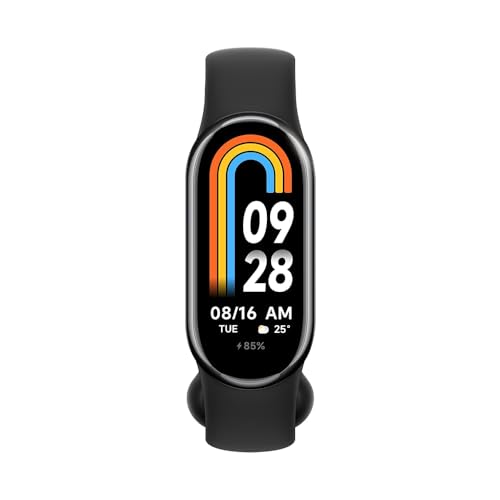
Xiaomi Smart Band 8: compact, lightweight rectangular module that sits low on the wrist and favors minimal bulk for 24/7 wear. The included band is soft TPU with a standard pin closure; third‑party replacement bands are widely available.
Samsung Galaxy Fit 3: larger footprint but thinner profile. Aluminum body with a glass front gives a more premium feel; the wider chassis may look and feel bigger on small wrists. Standard silicone straps are secure and replaceable.
Screen specifics and visual experience
Xiaomi Smart Band 8: 1.62″ AMOLED — sharp text and deep blacks for notifications and watchfaces.
Samsung Galaxy Fit 3: 1.6″ sAMOLED — similarly sharp but with typically higher peak brightness and punchier colors, which improves outdoor visibility.
Both panels are AMOLED-type, delivering high contrast and vivid colors. In direct sunlight the Galaxy Fit 3 tends to remain more legible thanks to stronger peak brightness; the Smart Band 8 still performs well but can require angling in very bright conditions. Touch responsiveness on both is snappy for swipes, taps and quick menu navigation.
Always-on display, customization & watchfaces
Both devices support an always-on display option and extensive watchface customization. Samsung advertises 100+ built-in watchfaces; Xiaomi offers a large library of downloadable faces via its companion apps. That makes both good for personalizing look and glance information.
Durability & water resistance
Samsung Galaxy Fit 3: aluminum body, advertised 5ATM + IP68 (swim-ready and dust resistant).
Xiaomi Smart Band 8: water resistant (designed for everyday wear and workouts); chassis is lightweight but less explicitly rugged than the Galaxy Fit 3.
Both trackers use small magnetic pogo‑pin chargers that attach to the band module.
Expect a full charge in roughly 1.5–2 hours depending on the charger and cable; partial top‑ups are fast (15–30 minutes gives a useful boost).
Battery‑saving features and software impact
Power modes: both offer battery saver modes that disable AOD, reduce heart‑rate sampling, and silence notifications to extend life significantly.
Display settings: brightness, AOD, and animated watchfaces are the single biggest drain—lower brightness and static faces add days.
Sampling frequency: switching continuous HR/SpO2 from real‑time to periodic (e.g., every 10–30 minutes) noticeably lengthens runtime.
Third‑party watchfaces and frequent vibration/notification-heavy phones will shorten real world battery life on both devices.
3
Health, Fitness Tracking & Software Experience
Sensors & accuracy
Both trackers pack optical heart‑rate, SpO2 readings, accelerometer and gyroscope sensors, plus sleep and stress (HRV‑based) monitoring. Expect reliable trend data: resting HR and nightly sleep stages are generally solid; readings during high‑intensity intervals and SpO2 values can swing and are not clinical‑grade. Samsung leans heavier on sleep coaching and snore detection as part of its wellness suite.
Xiaomi Smart Band 8 offers continuous HR and SpO2 monitoring with frequent sampling options for deeper trend analysis; it’s best used for day‑to‑day fitness insights rather than precise medical metrics.
Samsung’s Fit 3 augments similar sensors with more polished sleep analytics and built‑in coaching features that show up in Samsung Health.
Workouts, auto detection & GPS behavior
Galaxy Fit 3: ships with 100+ exercise modes and several automatic activity detections (running, walking, cycling, etc.).
Xiaomi Smart Band 8: wide library of preset sports modes and automatic workout detection for common activities.
Both trackers rely on connected (phone) GPS for route and pace — neither has a full onboard GPS module — so bring your phone for accurate outdoor tracking.
Apps: Xiaomi syncs to Xiaomi Wear/Zepp Life (names vary by region) with basic trends and export options; Samsung uses Samsung Health + Galaxy Wearable with richer coaching, better cross‑service sharing and tighter Samsung phone integration.
On‑device workout UX: Galaxy Fit 3’s larger, more refined 1.6″ AMOLED gives faster controls and clearer metrics mid‑workout; Xiaomi’s 1.62″ display is also very readable but the UI feels simpler.
Notifications & complications: Both show notifications, caller ID and simple replies (Android only, best on Samsung phones).
Watchfaces & integrations: Galaxy Fit 3 advertises 100+ official faces and polished system themes; Xiaomi supports many community and third‑party faces, giving more variety for customization.
4
Price, Value & Ecosystem — Which Delivers More for the Money
Amazon pricing & typical discounts
Both trackers sit in the same budget bracket on Amazon (roughly $45–$55 at time of listing). Expect occasional 10–30% cuts during Prime Day, Black Friday or seasonal sales; daily prices can fluctuate by a few dollars. Use Amazon’s price history tools and watch for “coupon” ticks on the product page.
Regional models, warranty & support
Xiaomi Smart Band 8 (Global): firmware and app names vary by region; warranty coverage depends on seller/region — Amazon returns are usually the safety net.
Samsung Galaxy Fit 3 (International): better-known global support network but some advanced features are optimized for Samsung phones; international models sometimes have limited manufacturer warranty outside specific markets.
Accessory availability & ecosystem
Xiaomi: large third‑party strap market, many community watch faces and mods; strong value for customization.
Samsung: fewer third‑party bands but more premium official accessories and tighter integration with Samsung Health and Galaxy devices.
Buyer trade-offs
Display vs battery vs tracking: both have sharp AMOLED screens; Galaxy Fit 3 emphasizes polished sleep coaching and aluminum build, while Xiaomi focuses on maximal value with solid tracking and broad third‑party customization. Battery performance is comparable in real use; Samsung’s software optimizations often stretch runtime on its platform.
Who should buy which
Buy Xiaomi Smart Band 8 if you want maximum bang-for-buck, wide strap/watchface choices, and strong core fitness features on a budget.
Buy Samsung Galaxy Fit 3 if you own a Samsung phone, want sleeker hardware, better native health coaching, and stronger manufacturer support.
Pros — Xiaomi Smart Band 8
Very competitive price
Broad accessory and face ecosystem
Strong day‑to‑day tracking
Pros — Samsung Galaxy Fit 3
Polished app experience with Samsung Health
Premium build and sleep coaching
Better manufacturer support network
Cons — Xiaomi Smart Band 8
Warranty/support varies by region
Cons — Samsung Galaxy Fit 3
Some features work best with Samsung phones
Slightly fewer low‑cost third‑party accessories
Final Verdict: Which Offers Better Value?
Xiaomi Smart Band 8 delivers the best value overall — richer fitness features and a lower price, while the Samsung Galaxy Fit 3 wins on display polish and UX.
Choose Samsung if you prioritize battery life or a refined 1.6″ AMOLED experience; choose Xiaomi for comprehensive tracking, value, and lower cost. Fitness enthusiasts and budget buyers should favor Xiaomi; display/UX-focused users and battery-prioritizers should pick Samsung. Verify current Amazon listings, recent firmware updates, and user reviews before buying. Which one fits your priorities? Check discounts and warranty terms too.
No replies needed, but wanted to say the battery numbers in the article seem realistic. I had a band last year whose “14 days” turned into 7 after a week of heavy notifications. So take marketing with a grain of salt. Also, nice comparison overall!
Zoe Wilson
on October 8, 2025
Minor nitpick: I wish Samsung included more native watch faces for Fit 3 out of the box. I get there are 100+ watchfaces but half are similar. Xiaomi’s app had cooler community designs IMO.
Priya Patel
on October 8, 2025
Totally — community watchfaces are where Xiaomi shines. But Samsung’s quality control means less weird/clipping faces.
Yep — value is a strong suit for the Smart Band 8. For users who want a premium screen and interface, Fit 3 is the tradeoff.
Emma Carter
on October 15, 2025
Exactly — for everyday gym and sleep tracking, Xiaomi does everything I need. Save the money and get extra straps 😉
Priya Patel
on October 21, 2025
Okay, long rant incoming (sorry):
I totally love the idea of 14 days battery. But in real life, features like continuous HR, sleep tracking, and a few push notifications bring that down. I had a Band 7 that hit 12 days once, then after an update battery life tanked to 6. Firmware matters.
Also, anyone else annoyed by limited custom workouts? Xiaomi has lots of exercise modes but the Fit 3’s UI for logging workouts is nicer.
Overall: Xiaomi = bang for buck, Samsung = nicer daily experience. Your mileage will vary depending on usage and firmware updates.
Great point about firmware — updates can help or hurt battery. We try to note that in comparisons because it’s a common real-world factor.
Kevin O'Neal
on October 21, 2025
Anyone know which brand has a better update track record? I feel Xiaomi updates more often but Samsung’s seem more stable.
Maria Garcia
on October 22, 2025
This!! I lost a ton of battery after a minor update on my last band. So annoying.
Zoe Wilson
on October 22, 2025
FWIW I got 13 days on Fit 3 with notifications off and AOD disabled. Not bad at all.
Lucas Martin
on October 22, 2025
Xiaomi pushes plenty of updates but they can be hit or miss. Samsung is slower but usually smoother.
Mike Thompson
on October 24, 2025
Long read but worth it. A few thoughts from someone who cycles and runs a lot:
– GPS: neither band has built-in GPS, so you’ll depend on phone-GPS. That’s fine for casual runners but annoying if you like phone-free outings.
– Battery vs features: the Fit 3’s AMOLED is gorgeous but I noticed it eats battery faster when always-on is turned on (duh). Xiaomi squeezes more days by keeping the UI simpler.
– Sensors: HR/SpO2 both are acceptable for trends, not clinical accuracy.
TL;DR: Pick Fit 3 if you prize display and polish. Pick Smart Band 8 for raw value and longer juice.
Priya Patel
on October 24, 2025
Which one do you prefer for cycling specifically? Does either handle cadence or cadence sensors well?
Neither has dedicated cadence sensor support built-in like some cycling head units. They can show basic speed/HR from phone apps. For serious cycling metrics, a dedicated bike computer is better.
Lucas Martin
on October 25, 2025
Good point on AOD — on Fit 3 I left it off and got close to the 14 days. Screen looks amazing when I do turn it on though.
Daniel Kim
on October 25, 2025
Agree on GPS — I lost my route once because I forgot the phone. 😂 For long rides I always bring the phone for safety anyway.
Olivia Brown
on October 25, 2025
Cadence via Bluetooth sensors depends on the app bridging it — not the band itself. Most casual users won’t notice.
Henry Scott
on October 26, 2025
For cycling I just use Strava on my phone and sync HR. Not perfect but works.
Chloe Turner
on October 27, 2025
I chuckled at the “100+ exercise modes” — it’s nice marketing but half are obscure stuff like ‘hula hooping’ or ‘lawn mowing’ 😆
Still, the variety is fun, and the daily stats are useful. If you want a fitness tracker that doesn’t scream “gadget,” Fit 3 is sleeker. If you want utility and mods: Xiaomi.
Ha — true! Those niche modes are often there for completeness. Good to know they still get used by some users though.
Emma Carter
on October 27, 2025
Hula hooping mode? Where have I been… 😂
Daniel Kim
on October 28, 2025
I’ll take ‘lawn mowing’ over ‘ice sculpting’ mode any day. Practicality wins.
Emma Carter
on November 9, 2025
Really helpful comparison — thanks! I own the Smart Band 8 and honestly the display is brighter than I expected for the price. Battery lasts about 10–11 days with notifications on and daily workouts.
That said, the Galaxy Fit 3’s AMOLED looks gorgeous and seems more “premium” on the wrist. I’m torn between staying in Xiaomi’s ecosystem (cheap straps, MI app) or splurging for the Samsung’s screen and 14-day battery claim.
Anyone here tried both for swim tracking or continuous SpO2 overnight? Curious about real-world accuracy.
Olivia Brown
on November 10, 2025
I had the Band 7 before switching to Fit 3 — Samsung’s sleep data felt slightly more coherent to me, but it’s subjective. Also Fit 3 straps are a pain to find cheap replacements for 😅
Mike Thompson
on November 10, 2025
If you like tinkering, Xiaomi’s ecosystem has tons of watchfaces and unofficial stuff. Fit 3 is slick but more locked down.
Glad the article helped! For swim tracking, both handle pool swims fine for basic laps. SpO2 overnight is decent on both but keep expectations modest—neither replaces medical devices. If screen quality matters most, Fit 3 wins; for value and accessories, Smart Band 8 is great.
Daniel Kim
on November 12, 2025
Does anyone have experience with notifications? I need reliable message previews and quick replies (especially on Android). Which one handles this better?
Both show notifications reliably on Android. Samsung offers a slightly snappier feel and some quick reply options, but Xiaomi supports quick replies too (depends on Android version and app). If quick replies are critical, Fit 3 is a bit more polished.
Mike Thompson
on November 13, 2025
On my Pixel, Xiaomi sometimes delays action buttons on notifications. Fit 3 felt faster.
Emma Carter
on November 13, 2025
I get quick replies on Band 8 but only with certain messaging apps. YMMV.
Priya Patel
on November 13, 2025
I use WhatsApp mostly — Band 8 shows the message and I can send a quick canned reply. Good enough for me!
Kevin O'Neal
on November 13, 2025
Short and sweet: got a Smart Band 8 for my mom, she loves the battery and simple UI. For me I’d pick the Fit 3 for looks. Both solid buys depending on what you value.
John Lee
on November 20, 2025
Quick Q: does Smart Band 8 support third-party watch faces or do I need to sideload? I don’t want to be stuck with boring ones.
Officially, the Smart Band 8 supports many watch faces through the Xiaomi app and third-party apps (some unofficial ones let you sideload custom faces). Just be cautious with unverified sources.
Henry Scott
on November 23, 2025
Anyone tested the heart rate accuracy during HIIT? I need decent HR for interval training.
Mike Thompson
on November 24, 2025
I used both during sprints. Neither is perfect during rapid HR changes — optical sensors lag. They track trends fine but don’t expect chest-strap accuracy.
Olivia Brown
on November 25, 2025
I like small, comfy bands and the Smart Band 8 felt lighter on my wrist. The Samsung is chunkier but looks more like a mini-watch.
Both are solid, honestly. Price-to-value leans Xiaomi for me, but Samsung’s UI feels smoother.






No replies needed, but wanted to say the battery numbers in the article seem realistic. I had a band last year whose “14 days” turned into 7 after a week of heavy notifications. So take marketing with a grain of salt. Also, nice comparison overall!
Minor nitpick: I wish Samsung included more native watch faces for Fit 3 out of the box. I get there are 100+ watchfaces but half are similar. Xiaomi’s app had cooler community designs IMO.
Totally — community watchfaces are where Xiaomi shines. But Samsung’s quality control means less weird/clipping faces.
Thanks — we tried to show watchface variety in the images. Community faces are a plus for Xiaomi, while Samsung maintains a curated library.
I actually prefer curated faces. Too many choices = decision paralysis 😂
Price-wise, the Smart Band 8 is a steal. If you’re not into all-day display or fancy watch faces, save the cash.
Also the band customization options for Xiaomi are insane — case, straps, DIY faces. Samsung is more locked down but cleaner.
Yep — value is a strong suit for the Smart Band 8. For users who want a premium screen and interface, Fit 3 is the tradeoff.
Exactly — for everyday gym and sleep tracking, Xiaomi does everything I need. Save the money and get extra straps 😉
Okay, long rant incoming (sorry):
I totally love the idea of 14 days battery. But in real life, features like continuous HR, sleep tracking, and a few push notifications bring that down. I had a Band 7 that hit 12 days once, then after an update battery life tanked to 6. Firmware matters.
Also, anyone else annoyed by limited custom workouts? Xiaomi has lots of exercise modes but the Fit 3’s UI for logging workouts is nicer.
Overall: Xiaomi = bang for buck, Samsung = nicer daily experience. Your mileage will vary depending on usage and firmware updates.
Great point about firmware — updates can help or hurt battery. We try to note that in comparisons because it’s a common real-world factor.
Anyone know which brand has a better update track record? I feel Xiaomi updates more often but Samsung’s seem more stable.
This!! I lost a ton of battery after a minor update on my last band. So annoying.
FWIW I got 13 days on Fit 3 with notifications off and AOD disabled. Not bad at all.
Xiaomi pushes plenty of updates but they can be hit or miss. Samsung is slower but usually smoother.
Long read but worth it. A few thoughts from someone who cycles and runs a lot:
– GPS: neither band has built-in GPS, so you’ll depend on phone-GPS. That’s fine for casual runners but annoying if you like phone-free outings.
– Battery vs features: the Fit 3’s AMOLED is gorgeous but I noticed it eats battery faster when always-on is turned on (duh). Xiaomi squeezes more days by keeping the UI simpler.
– Sensors: HR/SpO2 both are acceptable for trends, not clinical accuracy.
TL;DR: Pick Fit 3 if you prize display and polish. Pick Smart Band 8 for raw value and longer juice.
Which one do you prefer for cycling specifically? Does either handle cadence or cadence sensors well?
Neither has dedicated cadence sensor support built-in like some cycling head units. They can show basic speed/HR from phone apps. For serious cycling metrics, a dedicated bike computer is better.
Good point on AOD — on Fit 3 I left it off and got close to the 14 days. Screen looks amazing when I do turn it on though.
Agree on GPS — I lost my route once because I forgot the phone. 😂 For long rides I always bring the phone for safety anyway.
Cadence via Bluetooth sensors depends on the app bridging it — not the band itself. Most casual users won’t notice.
For cycling I just use Strava on my phone and sync HR. Not perfect but works.
I chuckled at the “100+ exercise modes” — it’s nice marketing but half are obscure stuff like ‘hula hooping’ or ‘lawn mowing’ 😆
Still, the variety is fun, and the daily stats are useful. If you want a fitness tracker that doesn’t scream “gadget,” Fit 3 is sleeker. If you want utility and mods: Xiaomi.
Ha — true! Those niche modes are often there for completeness. Good to know they still get used by some users though.
Hula hooping mode? Where have I been… 😂
I’ll take ‘lawn mowing’ over ‘ice sculpting’ mode any day. Practicality wins.
Really helpful comparison — thanks! I own the Smart Band 8 and honestly the display is brighter than I expected for the price. Battery lasts about 10–11 days with notifications on and daily workouts.
That said, the Galaxy Fit 3’s AMOLED looks gorgeous and seems more “premium” on the wrist. I’m torn between staying in Xiaomi’s ecosystem (cheap straps, MI app) or splurging for the Samsung’s screen and 14-day battery claim.
Anyone here tried both for swim tracking or continuous SpO2 overnight? Curious about real-world accuracy.
I had the Band 7 before switching to Fit 3 — Samsung’s sleep data felt slightly more coherent to me, but it’s subjective. Also Fit 3 straps are a pain to find cheap replacements for 😅
If you like tinkering, Xiaomi’s ecosystem has tons of watchfaces and unofficial stuff. Fit 3 is slick but more locked down.
Glad the article helped! For swim tracking, both handle pool swims fine for basic laps. SpO2 overnight is decent on both but keep expectations modest—neither replaces medical devices. If screen quality matters most, Fit 3 wins; for value and accessories, Smart Band 8 is great.
Does anyone have experience with notifications? I need reliable message previews and quick replies (especially on Android). Which one handles this better?
Both show notifications reliably on Android. Samsung offers a slightly snappier feel and some quick reply options, but Xiaomi supports quick replies too (depends on Android version and app). If quick replies are critical, Fit 3 is a bit more polished.
On my Pixel, Xiaomi sometimes delays action buttons on notifications. Fit 3 felt faster.
I get quick replies on Band 8 but only with certain messaging apps. YMMV.
I use WhatsApp mostly — Band 8 shows the message and I can send a quick canned reply. Good enough for me!
Short and sweet: got a Smart Band 8 for my mom, she loves the battery and simple UI. For me I’d pick the Fit 3 for looks. Both solid buys depending on what you value.
Quick Q: does Smart Band 8 support third-party watch faces or do I need to sideload? I don’t want to be stuck with boring ones.
Officially, the Smart Band 8 supports many watch faces through the Xiaomi app and third-party apps (some unofficial ones let you sideload custom faces). Just be cautious with unverified sources.
Anyone tested the heart rate accuracy during HIIT? I need decent HR for interval training.
I used both during sprints. Neither is perfect during rapid HR changes — optical sensors lag. They track trends fine but don’t expect chest-strap accuracy.
I like small, comfy bands and the Smart Band 8 felt lighter on my wrist. The Samsung is chunkier but looks more like a mini-watch.
Both are solid, honestly. Price-to-value leans Xiaomi for me, but Samsung’s UI feels smoother.
Comfort is subjective — strap material and weight make a big difference. Good to hear Band 8 felt lighter for you.
Agree — Xiaomi feels like wearing nothing, Samsung feels like wearing a tiny smartwatch. Depends on your style.
Love the breakdown of battery vs display. I’m indecisive and these little details helped me decide.
Small note: the Fit 3’s 1.6″ screen is bigger than my old band and looks lovely when cycling through metrics. But straps need extra care in rain.
Also consider buying a screen protector for the AMOLED — scratches show more on that finish.
I wash my straps weekly — keeps them from smelling like gym. Cheap rubber straps can degrade though.
If you live somewhere rainy, get a good TPU strap. Saved my band.
Glad it helped! Good tip about water exposure — both are water-resistant but regular cleaning helps longevity.