
Cockpit knocks, hard landings and steady vibration force a choice between preserving a mechanical heirloom or choosing rugged reliability.
During bumpy approaches or when topping the rudder on a hot ramp, a sudden shock can misalign a movement or pop a crystal. This section prioritizes resilience over style: focus on hardened crystals, robust cases, secure straps and shock‑resistant movements that survive repeated vibration.
Rugged pilot picks


How cockpit vibration is different from a one‑off knock
Cockpit vibration is not just louder knocks — it’s a mix of continuous, high‑frequency inputs from engine harmonics, control inputs, prop or rotor pulses and turbulence. Those inputs create thousands of tiny reversals and micro‑shocks per hour, and that repetition drives fatigue and resonant amplification in watch parts.
The parts that suffer most are small, delicate, and exposed to motion:
- Balance staff and pivots (fatigue cracks from oscillatory stress)
- Hairspring and escapement (timing amplitude changes from repeated disturbances)
- Gear train teeth and jewels (accelerated wear and oil displacement)
- Spring bars, lugs and crowns (loosening or shearing under repeated load)
- Crystals and case screws (micro‑fractures and backing deformation)
Frequency matters because a repeated small force at a resonant frequency can produce larger internal motion than a single big hit; cumulative micro‑shock causes loosening, oil migration and tiny cracks long before a dramatic failure. For material choices and mass effects — which change how a case responds to vibration — consult discussions about are titanium watches lighter than steel when deciding case metals and strap setups.
Look for watches with proven shock protection, secure fixed bars or screw bars, and plan more frequent servicing if flown heavily.
Common vibration failures and a short inspection checklist
-
Loose or misaligned hands
Set hands to 12:00 and tilt the watch; look for wobble, stutter or misalignment. Loose hands or a slipping cannon pinion are classic vibration‑accelerated failures.
-
Crown security and stem play
Operate the crown through all positions and feel for axial play or rough engagement. A crown that wobbles or won’t screw down reliably can fail under vibration.
-
Rattling rotor or movement noise
Hold the watch to the ear and gently rotate the case. Excessive rattling, grinding or irregular sounds point to worn bearings or loose movement components.
-
Loose screws and caseback gaps
Inspect caseback and visible screws for gaps or movement. Loose screws and an unseated caseback invite accelerated wear and moisture ingress.
-
Crystal chips and bezel play
Examine the crystal edge for hairline cracks and rotate the bezel to check lateral play. Chips and sloppy bezels worsen with repeated vibration.
-
Strap, endlinks and springbars
Pull at the strap and wiggle endlinks to check for springbar fatigue or fraying. Replace worn bars or straps before flight; they’re the most common failure in rough use.
If any issue appears, delay use and have a watchmaker inspect it; avoid buying used watches that show multiple warning signs.
Wear test: strap the watch and walk for 5–10 minutes while listening for rattles.
Hands‑on check: wind and set the time while watching hand sweep and crown feel; erratic motion reveals problems.
Testable criteria for vibration resilience
Choose movements with built‑in shock protection (Incabloc/KIF) or low‑part-count quartz/meca‑quartz calibers; they tolerate repeated micro‑shocks and reduce hand/gear loosening.
A sturdy case, secured crystal and screwdown or well‑sealed crown limit flex and particulate ingress that amplify vibration damage.
Fixed lugs or reinforced springbars plus stitched or riveted straps stop the most common failures; for budget options see durable pilot watches under $200 for examples and upgrades.
Prefer watches using common movements and replaceable crystals/straps so worn parts can be swapped before damage spreads; proprietary glued modules are hard to fix.
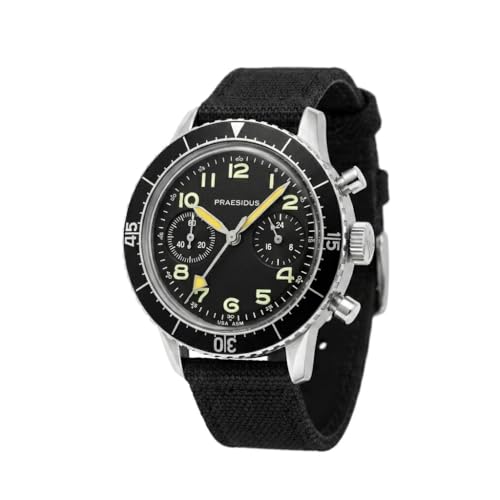
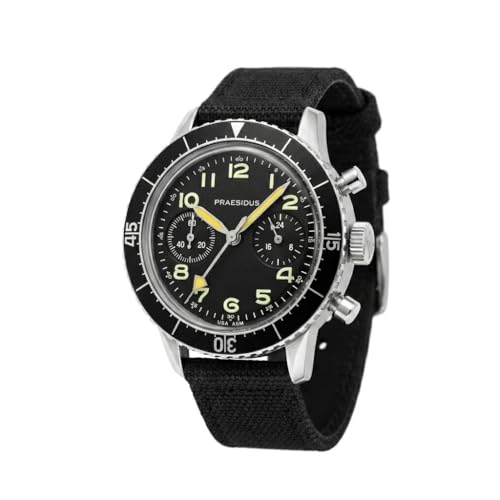
Meca‑quartz chronograph, USA assembled
38mm pilot chronograph with black dial and black canvas strap. Uses a meca‑quartz chronograph movement and is USA assembled; water resistant to 10 ATM. Historically styled after helicopter pilot watches and offered at an accessible price. Vibration notes: meca‑quartz reduces delicate gear trains, and the canvas strap is durable—verify springbar thickness and crown sealing before heavy cockpit use.
Quartz or mechanical: choose by mission
Pick by mission profile
For high‑vibration, safety‑critical flights—repeated turbulence, rough field ops, or austere deployments—quartz is the pragmatic choice: fewer moving parts, steadier accuracy under shock, and less frequent servicing. For office‑style IFR flying, heritage flights, or when aesthetic and mechanical character matter, a mechanical watch can work if selected and maintained with vibration in mind.
Mechanical features that reduce vibration risk
- Shock protection (Incabloc/KIF/Diashock): protects the balance staff from sudden knocks.
- Secure balance bridge or full bridge: reduces movement of the balance wheel under sustained vibration.
- Silicon or flat hairspring: better resilience against deformation and magnetism.
- Robust case construction: screw‑down crown/caseback and thicker crystal to keep contaminants and flex out.
- Reinforced hand and dial fittings: minimizes loose hands and slipping under repeated shocks.
- Serviceable, modular movement: easier post‑flight repairs and parts replacement.
Pre‑flight checks: tighten the crown, verify springbar security, and prefer a solid strap. For model ideas that balance cockpit use and accuracy, consult the IFR-ready builds and vibration resilience reference.
Keep it regularly serviced. Even vibration‑tolerant movements need scheduled inspection—focus on balance pivots, crown stem security, and springbar condition.
Make the attachment point fail‑safe
-
Pick a redundant strap style
Prefer a one‑piece NATO or a fixed‑lug strap so the case stays attached if one springbar fails. Start with straps designed as straps that keep watches secure under a cuff.
-
Fit heavy hardware
Use reinforced springbars or screw bars rated for rough use; avoid cheap folded bars. Choose stainless or PVD‑coated hardware to resist wear and corrosion.
-
Set tension and routing
Seat springbar ends fully, pull the strap snug (not tight) so the watch won’t slide, then tuck the tail into keepers to remove slack.
-
Add simple backups
Route a thin retention loop or safety lanyard through fixed springbar holes, or use a double‑pass NATO so losing one bar still holds the case.
-
Do a pre‑flight check
Give the watch a firm tug, inspect springbar seating and frayed nylon, rotate the wrist to confirm no movement, and verify crown and bezel security.
Heavy ballistic G10 nylon
NATO G10 XTREME heavy ballistic nylon, 20/22mm sizes, ~295mm length and 1.5mm thickness. Stainless steel buckle and keepers; water resistant; USA stock. Includes a free set of spring bars—handy when replacing weak bars in the cockpit. Approx price: ~$30.
Fast vetting routine
A fast vetting routine narrows candidates to those with the best chance of surviving cockpit vibration. Focus on attachment points, crystal security and whether the chrono functions feel solid.
In‑store checklist
- Check the crown and pushers: crown should screw down (if applicable) and pushers must not rattle. Test chronograph start/stop/reset for firm action.
- Inspect crystal and bezel: look for chips, movement under the crystal, and a snug bezel fit. Slight play indicates looseness.
- Verify springbars and strap: tug gently at the lugs and feel for play; reinforced springbars or thick NATOs are preferable.
- Listen for movement noise: loud rotor or loose parts often means service is needed.
Online checks & questions
Prioritize rugged chronographs, IFR/instrument‑style cases, or budget models known for simple, tough quartz movements — especially chronographs built for rough use. Ask the seller:
- “Any service history or timing records?”
- “Are crystals, crowns, or springbars original?”
- “Can additional high‑res photos of the lug ends and movement be provided?”
A short checklist and these three questions eliminate most risky buys.
Atomic timekeeping; rugged pilot chronograph
Features: Atomic timekeeping across 43 cities, 1/100s chronograph to 24 hours, perpetual calendar, dual time, power reserve indicator. Build: Black ion‑plated steel, anti‑reflective mineral crystal, black rubber strap, 200 m water resistance. Movement: Eco‑Drive (solar) — never needs a battery. Known for practical avionics features and straightforward serviceability. Approx. price: ~$420.
Three-line decision rule and immediate steps
When ready to decide, follow a concise rule and run a short vetting routine. For basic background on purpose-built designs, consult what is a pilot watch.
Rule 1: If the watch must survive mission‑critical vibration, pick a quartz or a mechanical with documented shock protection and reinforced attachment points. Rule 2: If comfort and long serviceability matter more than absolute shock tolerance, choose a well-built mechanical and commit to regular service. Rule 3: If uncertainty remains, prefer simplicity — fewer complications and a fixed bezel reduce failure modes.Immediate next steps: perform the fast vetting checks (crown security, hand tightness, springbars, crystal seating), ask sellers or makers about explicit shock protection and case fastening, and consider a quartz movement for heavy‑vibration roles. Maintain a service schedule, inspect straps and springbars before flights, and log any knocks for early servicing.
Good checklist — I always forget to wiggle the crown before a flight. Quick crown and strap check caught a loose springbar once for me.