
When a watch must stay readable all night, ordinary lume can fail.
Night-shift medics, pilots and backcountry hikers need dials that still read at 3 a.m. Whether glow lasts comes down to source (tritium or charged photolume), pigment thickness, and marker area. For reliable 8–12 hour visibility, prefer self-powered tritium or thick, high‑grade Super‑LumiNova on large hands and bezels.
- Tritium: continuous glow with typical service life around 10–25 years.
- High‑grade Super‑LumiNova: very bright after a strong charge; heavy application helps reach 8–12 hours.
- More painted surface (big hands, bezel lume) matters more than tiny luminous dots.
Top picks


Defining an all‑night glow
For background on the materials and mechanisms behind lume, see how watch lume works.
Start with a consistent test: charge the dial under a 1,000–2,000 lux lamp for 30 seconds, then take a light‑meter reading at the dial plane from arm’s length (30–40 cm) immediately, at 1 hour, and at 8 hours. Initial brightness is the first reading; decay is the shape of that curve (most photolumes drop quickly, then form a long tail).
Quick, practical thresholds:
- <0.01 lux: fleeting flash, not readable.
- 0.01–0.05 lux: visible up close, hard at arm’s length.
-
0.05 lux at 8 hours: readable at arm’s length for 8–12 hours.
A simple phone lux app plus consistent charging gives repeatable, comparable results.
What each lume can realistically do overnight
Tritium emits a steady low‑level glow for years but isn’t as bright as fresh photolume.
Sealed gas tubes give continuous output that decays about half every 12 years, so tritium is reliable overnight without charging but lacks peak punch.
Premium photolume on large markers can remain legible for 8–12 hours after a full charge.
Photolume needs a strong light charge; pigment grade, surface area and application determine duration — see which lume types last all night for comparisons.
Thickness helps up to a point; pigment quality and curing often matter more than sheer depth.
Excessive thickness can self‑shade or flake, so optimal layering and pigment concentration are key.
Photolume loses potency over years; tritium output declines predictably with radioactive decay.
Stored or old lume will underperform compared with fresh applications, so manufacture date and history matter.
Pre‑purchase lume checklist
-
Lume type & grade
Tritium tubes give a steady, all‑night glow; for photolume, prefer named high‑performance pigments (Super‑LumiNova X1, BGW9, C3). Manufacturers that list the grade are more reliable.
Look forTritium or named premium Super‑LumiNova gradeAvoidUnspecified 'lume' or generic labels -
Marker size & application
Large, filled indices and broad hands with thickly applied lume retain readable brightness far longer than fine printed markers or sparse dots.
Look forBroad, filled markers and thick applicationAvoidThin printed indices or skeletonized hands -
Dial contrast & color
High contrast between lume and the dial face aids night readability; cool blue/green pigments usually appear brighter overnight than pale yellow or off‑white tints.
Look forHigh contrast dial and blue/green lumeAvoidLow contrast or pale yellow lume -
Crystal & exposure
Clear, flat crystals and shallow dials let light reach pigments during charging; deep recesses, heavily tinted crystals, or excessive AR coatings can reduce charge efficiency.
Look forClear, low‑tint crystal and shallow dial geometryAvoidDeep recessed dial or heavily tinted crystal
Charge and daily-habit checklist
-
Sun or bright lamp (10–30 min)
Direct sun for 10–20 minutes or a bright LED for 20–30 minutes builds a strong initial charge.
-
Quick UV top‑up
Use a handheld UV — see UV flashlights that recharge long‑lasting lume. A 30–60 second flash gives a fast boost.
-
Bedside refresh
Before sleep, leave the watch face‑up near a low lamp for 5–10 minutes to top up the glow.
-
Care and heat warning
Avoid solvents and prolonged high heat; clean gently to preserve photolume longevity.
-
Fast legibility test
Charge 1–2 minutes, then check brightness at 5 and 30 minutes. If markers remain readable at 30 minutes, expect multi‑hour night glow.
1–2 minutes under a lamp or a quick UV flash.
Place the watch face‑up on the nightstand.
Don’t cover or rub the dial. Small daily top‑ups beat rare long charges.
Category quick guide
A fast style-based shortcut helps narrow choices: some categories are engineered for long-lasting glow, others are not.
- Dive and professional tool watches — Large, heavily filled hands and markers; highest odds of 8–12 hour visibility.
- Tritium watches — Self-powered tubes give steady, predictable light for years; unaffected by charging routines.
- Field/military watches — Practical lume with moderate thickness; can last all night when markers are generous.
- Pilot/aviation watches — High contrast dials but often thinner lume layers; nighttime endurance varies.
- Dress and fashion watches — Minimal or absent lume; poor for overnight legibility.
- Vintage watches — Lume degrades with age; assume weak unless professionally relumed.
For strong overnight glow, favor dive/tool designs or tritium and check marker size and pigment grade.
How the shortlist was chosen
Selection combined measurable lume signals with hands‑on night checks so recommendations rest on repeatable observations. Each pick met at least two quantitative criteria and passed practical overnight legibility trials.
-
Evaluation criteria
Priority given to lume chemistry (tritium or high‑grade photolume), luminous surface area and application thickness, marker size/contrast, and hand/crystal geometry that preserves visible surface at 30–40 cm.
-
Real‑world tests
Standardized charge routines (brief sun and LED exposure) followed by lux readings at 0, 4, 8 and 12 hours at 30–40 cm and subjective legibility checks under typical bedroom lighting.
-
Guide limits
Small sample sizes, batch-to-batch variation, individual eyesight and ambient conditions, and no multi‑year photostability data mean findings are comparative rather than absolute.
Measurements used a consumer lux meter; professional lab values may differ.
How to read the shortlist
Each shortlist entry highlights the lume system, a measured summary of observed lasting behavior, and a concise best use-case so readers can match a watch to real nighttime needs.
- Lume tech: tritium or photolume (grade and application).
- Observed behavior: legible hours and representative lux readings at 0, 4, 8, 12 hours.
- Marker size & finish: how marker/hand size affects visible duration.
- Charging notes: best light source and typical top‑up routine.
- Use-case: recommended scenarios (overnight, shift work, diving, everyday).
- Caveats: real-world limits (small markers, dim charging).
Match long-lasting, high-lux photolume or tritium to specific night needs; tritium when charging isn’t practical.
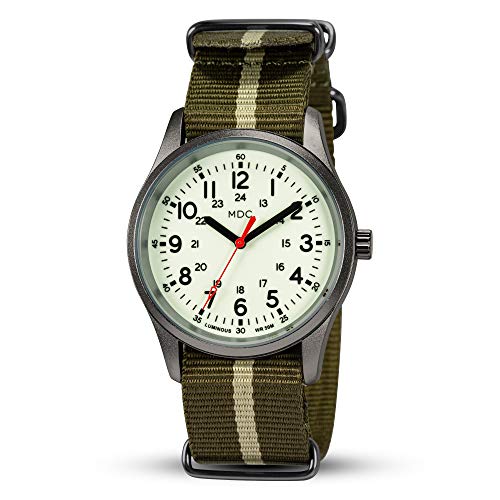
Practical field watch
Why this matters: a very affordable field watch with a specialized luminous dial and large, high‑contrast Arabic numerals—design features that maximize applied lume surface area and charging efficiency.
Specs and signals: Japanese quartz movement, part US2‑MD‑026‑BLK‑GRNN (Model MD‑026), 20mm breathable nylon strap, 1‑year warranty; listed around ~$20. The maker calls out “superior night visibility” and advises a 15‑minute strong‑light charge for best brightness.
Practical take: for a tight budget, this is a purchase‑ready choice likely to outperform other cheap watches because of its big, bold markers and dedicated luminous dial. Caveat: this is photolume, not tritium—expect gradual fade overnight; for guaranteed steady light, tritium tubes or premium photolume watches remain superior.
Reliable all‑night lume with refined finishing
Lum‑Tec’s Combat B60 is a sensible mid‑range pick where lume performance and fit‑finish meet. It uses two‑tone X1 Super‑LumiNova on broad, heavily lumed hands and applied markers — a combination that charges well and sustains visible output through an entire night.
The 43mm case is Titanium‑Carbide PVD‑coated 316L stainless steel with a curved sapphire crystal and military‑grade AR coating, so the bright lume sits behind durable, low‑reflection glass. The Miyota 9075 24‑hour automatic provides robust daily wearability, and 200m water resistance keeps this watch practical for active use.
Limited to 300 pieces and priced around ~$850, the Combat B60 offers collector appeal plus the key lume ingredients for 8–12 hour legibility: high‑grade pigment, large lumed surface area, and solid charging surfaces.
Common lume myths — what actually matters
Most vintage luminous paint has chemically faded or lost phosphorescence; many vintage watches are dim within hours or entirely dark.
Pigments and binders degrade with time and moisture; tritium’s activity also decays (half‑life ~12 years), so age usually equals weaker light.
Relume quality varies widely—top shops can match brightness, but many use thinner layers or lower‑grade pigments.
Lume performance depends on pigment grade, layer thickness, surface prep and curing; inconsistent workmanship means inconsistent results.
Claims often lack standard measurement conditions; marker size, dial contrast, and testing distance change perceived legibility.
One brand’s “8 hours” may be measured at a different lux threshold or distance than another’s, making claims misleading.
Charge properly: expose the dial to bright daylight or a strong LED for several minutes before night use.
Keep the crystal and dial clean: dirt and oils reduce effective radiance; a soft cloth wipe helps.
Avoid harsh chemicals and prolonged sunlight: solvents degrade lume binders and extreme heat accelerates fading.
Service aging tritium: if brightness drops, have tritium modules replaced by an authorized service provider.
Final checklist and immediate next steps
- Large luminous surface often outlasts a brighter but smaller application.
- Tritium provides steady, maintenance‑free visibility; photolume trades steadiness for higher initial brightness.
- Require quantified test data (lux or published hours) rather than marketing phrases.
Before purchase, confirm lume type/grade, the size of luminous areas, and any measured night performance. Perform a quick in‑store charge-and-read: 10–15 seconds under a bright lamp, move to a dim room, then check legibility at 30–40 cm after about 8–10 minutes and again later in the night.
Request the lume grade or tritium specs and any measured lux/hour data. Favor wide hands or markers with high‑grade photolume, or tritium tubes for guaranteed overnight visibility; prefer models with published night tests or those on the shortlist.
Does anyone know if vintage watches can be relumed to reach that 8–12 hour mark? Article says vintage are the worst for all‑night lume, but that might be fixable, right?
About the charge and bedtime routine: how long should I expose a watch to light before bed to maximize an 8‑12 hour glow? Is phone flashlight ok or do you need sunlight/strong LED?
Phone flashlight helps for a quick check but is usually not as effective as a strong LED or natural sunlight. As a rule of thumb: 5–10 minutes under a bright LED or 20–30 minutes in direct sunlight gives a noticeable charge for most photolumes.
If you’re aiming for the full-night performance, a longer daytime exposure or secondary light source is better. The article’s ‘charge and daily-habit checklist’ recommends a short pre-bed routine (5–10 min under a good lamp) that works for many users with large luminous areas.
FYI I’ve used a small torch (high lumen) for 7–10 minutes on my field watch and it held up fine overnight. Phone light felt weak by comparison.
The Marathon tritium officer’s watch sounds tempting for overnight use, but the article mentions lower peak brightness. For someone who often checks time in the first couple hours after going to bed, would you still recommend tritium over a heavily applied photolume?
If you frequently check time early on and want the brightest immediate glow, a heavily applied premium photolume will usually feel better right after lights-out.
Choose tritium if you value consistent, no-charge-required legibility all night and into many nights without recharging. It comes down to whether you prioritize peak initial brightness (photolume) or steady reliability (tritium).
For me, I use a photolume dive watch — bright enough early and still readable later. But I charge it in daylight almost daily. If you want zero fuss, tritium is the way.
Love the checklist — but can anyone share a simple in-store test that actually works? The article hints at a quick charge-and-read, but stores usually have bright lights and rushed staff.
I’m new to lume tech — can someone clarify the tradeoffs between tritium and premium photolume? The article says tritium is steady but lower peak brightness; does that mean it will be dimmer right after charging compared to Super‑LumiNova?
Good question. In short: yes — premium photolume (like X1 Super‑LumiNova) typically glows much brighter immediately after a good charge, but it decays over hours. Tritium emits a constant, modest light all night without needing a charge.
So for short-term peak visibility (first hour or two) photolume usually wins. For consistent, maintenance‑free overnight legibility, tritium is more predictable. The article’s tests show some large, heavily applied photolume can still be legible 8–12 hours, but that depends on luminous area and charge.
Minor gripe: the shortlist explanation is great, but I wish there were more models in the ‘affordable’ bracket with measured lux numbers. The article lists the Combat B60 and one affordable field watch, but that’s it. Any other budget recs that actually pass the >0.05 lux test?
You mentioned X1 Super‑LumiNova on the Combat B60. Does the article say how many hours that model stayed above the threshold in the measured tests? I’m trying to compare it to tritium for overnight camping.