
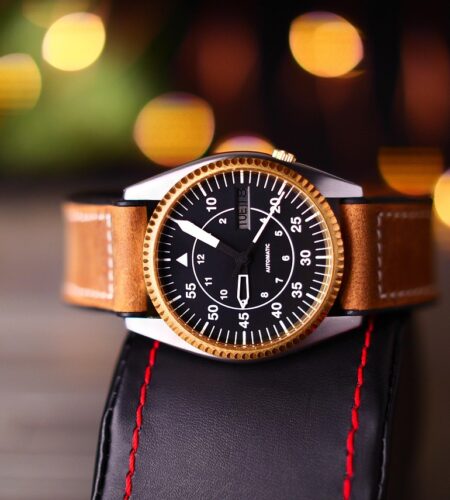
Is the 'pilot' label useful or just aviation styling?
A shopper pauses at a glass case, finger hovering over a crisp black dial stamped ‘Pilot.’ The watch has big numerals, an onion crown, and a rotating bezel — it looks right, but will those features actually help in the cockpit or serve only to sell an aesthetic?
This section separates practical pilot-watch features — legibility, oversized crown, reliable movement, navigation aids — from pilot‑style cues that are purely decorative. The aim is clarity: determine whether a piece is a genuine flight tool or an aviation‑inspired accessory before committing to a purchase.
Pilot watches as purpose‑built tools
A pilot watch is first and foremost a purpose‑driven instrument: a wristwatch designed to deliver crucial information clearly and quickly in an aircraft environment. Over time the label came to mean watches where legibility, timing, and basic navigation support are prioritized over ornament.
The form evolved from practical cockpit needs — oversized dials, bold numerals, luminous hands and large crowns for use with gloves — through the early 20th century into the wartime era when uniform standards and instrument compatibility mattered most. For a fuller chronology, consult the timeline of pilot watches, which traces how specific aviation demands codified those visual and mechanical cues.
essential vs decorative
- Essential features: high-contrast dial, large readable numerals/hands, reliable chronograph or stopwatch functions when required, robust case and anti‑magnetic protection. These were developed for clear utility.
- Decorative elements: cathedral hands, ornate bezels, excessive polishing, or faux cockpit markings that mimic function without improving usability.
Modern pilot watches often blend heritage styling with practical elements. When assessing a model, prioritize the structural traits that enable quick reading and dependable timing — those are the lineage’s real legacy.
Design cues that make a watch genuinely pilot‑oriented
Key design cues
- High dial contrast — a matte dial with white or cream markings against a dark background improves glanceability, letting a pilot read time instantly without hunting through reflections.
- Large, simple numerals — oversized Arabic numbers reduce cognitive load during brief cockpit glances and make seconds quicker to pick out under workload.
- 12 o’clock marker or triangle — a prominent triangular marker or double index provides an immediate orientation reference so the top of the dial reads correctly at a glance, especially in turbulence.
- Oversized onion or fluted crown — a big crown allows time-setting and winding while wearing gloves, solving the glove‑use problem common in older cockpits.
- Anti‑reflective (AR) crystal — AR coatings cut glare from instrument lighting and sunlight, preserving readability where reflections would otherwise hide hands.
- Strong lume on hands and indices — high‑performance luminous paint ensures low‑light readability during night flights or dim cockpits.
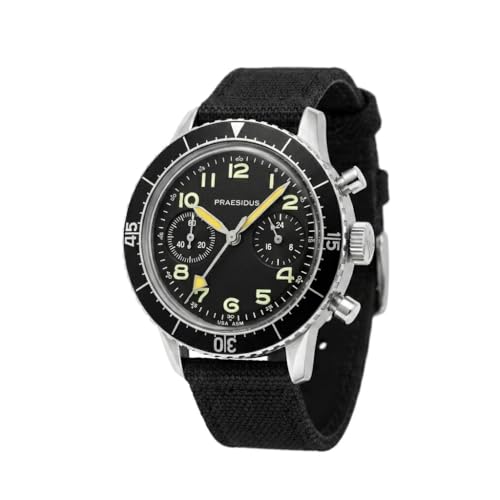
- Accessible pushers and large crowns — chronograph pushers and crowns placed and sized for deliberate operation prevent accidental presses and allow easy use with gloves.
Each cue targets a cockpit reality: quick glances, movement, low light, and gloved hands. For how physical features pair with onboard tools, consult the section on navigation features that help in‑flight.
When choosing a pilot watch, favor clear hands and contrast over extra complications; simple, readable design is the practical safety feature.
Pilot watch complications and how pilots use them
Pilot watches commonly add three purpose‑driven complications: the chronograph, a GMT/dual‑time hand, and a slide‑rule bezel. Each answers a different cockpit need—timing, timekeeping across zones, or quick calculations—and each trades simplicity for capability.
Common complications and in‑flight uses
Chronograph — Start/stop timing for flight legs, airwork, holds, engine run‑ups and short fuel checks. A simple routine: start at a waypoint, stop at the next to record leg time; use the split/second or lap feature to time holds without losing the overall elapsed time.
GMT / dual time — Keep local time on the main hands and set the GMT hand to Zulu (UTC) for ATC clearances and flight plans, or to a destination time when crossing time zones. It removes mental timezone conversions during busy phases.
Slide‑rule bezel — Perform multiplication/division for fuel burn, ground speed, distance and unit conversions without electronics. Common trick: set fuel consumption per hour opposite elapsed time to read remaining fuel requirement directly.
Tradeoffs and choosing the right tool
- Chronograph: excellent for precise timing; adds pushers and potential water‑resistance compromise.
- GMT: low complexity, persistent reference to Zulu; adds visual clutter if the dial is small.
- Slide rule: powerful but requires practice and is slower than digital calculators.
For a direct feature comparison consult a dedicated comparison of chronograph and GMT usefulness. Pick the complication that matches the primary mission—timing, timezone management, or on‑the‑fly math—and favor legibility over feature count.
Using a pilot watch in flight
Time approaches and holds with a chronograph
- Start the chronograph when abeam the outbound fix or when crossing the initial approach fix. Record the elapsed time for each segment.
- For holds, start on the inbound or outbound radial; use the split/lap function to track successive turns without losing total elapsed time.
- Use the chronograph to confirm published segment times (e.g., outbound leg 1 minute) and adjust headings or wind correction accordingly.
Set a GMT hand to Zulu (UTC)
- Check current Zulu time from ATC or an electronic source. Use the quick‑set hour hand or 24‑hour crown position to move the GMT hand to that UTC time.
- Leave the local hour hand on local time for immediate reference; verify alignment before departure and after long stops.
Use a slide‑rule bezel for quick conversions
- Align the index (10 or 60 mark) with the known value on the inner scale, then read the converted value opposite the target mark.
- Example: convert fuel burn by setting fuel‑flow rate on one scale and reading hours of endurance on the other.
Estimate groundspeed with only a watch
- Start the chronograph over a known-distance landmark, stop at the next; groundspeed = (distance in nm ÷ minutes) × 60.
- Example: 12 nm in 6 minutes → (12 ÷ 6) × 60 = 120 kt.
For hands‑on walkthroughs and practice exercises, see the related how‑tos below.
Pilot watches for IFR training and flight
Instrument students and instrument‑rated pilots benefit from pilot watches that do more than look the part. The most pedagogically and operationally useful features are a reliable chronograph, a clear Zulu/GMT reference, and strong lume for low‑light cross‑checks. For a deeper comparison, consult the which features to prioritize when choosing a pilot watch.
- Reliable chronograph: Use for timed holds, outbound/inbound timing, and approach/final segment checks. Prefer mechanical chronographs with positive pushers or quartz chronographs known for repeatable accuracy.
- Clear Zulu/GMT reference: A dedicated 24‑hour hand or marked bezel simplifies setting and reading Zulu without mental conversion during busy clearances.
- Strong lume and contrast: Bright, long‑lasting lume and high contrast numerals ensure rapid readback during night approaches or when cockpit lighting is dim.
When a watch helps — and when it doesn’t
A wristwatch is a useful backup for timing and cross‑checking flight logs, but it is insufficient as a primary navigation or IFR timing source. It cannot replace certified avionics for position, DME, or ATC time stamps during safety‑critical events.
Practical tips:
- Set the watch to Zulu at engine start and verify against the panel clock.
- Use the chronograph for discrete legs; record start/stop times in the kneeboard.
- Test lume before night flights and carry a small backup light.
Durability and straps in the cockpit
Cockpit environments demand more than good looks: repeated vibration, occasional shock, sweat, and the need to fit under a sleeve all affect which watches perform reliably. Durable case construction, proven movement shock protection, and a secure strap are the practical priorities.
Case and movement resilience
Choose cases with solid materials (stainless steel or titanium), a reinforced crystal (sapphire or hardened mineral), and a screw-down or well-sealed crown. Water resistance of at least 50–100 m gives peace of mind against sweat and spills. For movement durability, look for watches advertising shock protection (Incabloc, Parashock) or quartz calibres, which tolerate vibration better than many mechanical movements.
Straps and security
Preferred strap attributes include secure spring bars or fixed bars, a robust buckle, and enough length to fit over a cuff or flight suit. Common practical options:
- NATO or single-pass straps: high security if spring bars fail.
- Leather pilot straps with reinforced stitching: classic, comfortable under a cuff.
- Rubber or silicone: water‑resistant and easy to clean.
- Metal bracelets with solid end links and screw pins: very durable.
Budget picks and selection tips
On a budget, a quality NATO or rubber strap plus a watch with a sealed case and quartz movement delivers the best durability per dollar. For deeper guidance, see the related posts below on vibration‑resistant models, strap roundups, and budget pilot watches.

Common buyer myths — corrected
Choose size for legibility and comfort; oversized cases can be impractical.
Too-large watches snag sleeves and hinder gloved operation.
Lume helps, but contrast, hand shape and AR coating matter more.
Lume fades; contrast and AR reduce glare and speed reads.
Useful GMTs clearly mark Zulu and offer simple setting; complex displays hinder quick checks.
Small indicators are slower to read under workload than a 24‑hour hand.
Chronographs are useful only if registers are large and legible; avionics often substitute.
Tiny subdials blur in turbulence or low light, defeating the chrono’s purpose.
Prestige doesn’t ensure durability, secure straps, or practical legibility.
Durable construction and readable layout beat finish when safety matters.
Quick checklist: Is a pilot watch the right tool, and what to prioritize?
- Choose a pilot watch when regular flying, timing backups, or simple nav aid are needed — not just for looks.
- VFR priority: clear dial, reliable chronograph, and a secure strap.
- IFR training priority: precise chronograph, unambiguous GMT/Zulu display, and strong lume for low light work.
Decision checklist. Ask three quick questions: does flying frequency or mission need a wristborne backup, is timing/navigation functionality required, and does the chosen watch match budget and maintenance tolerance? If the answers favor a functional tool, proceed.
Priorities by use case. VFR — legibility, chronograph, secure strap. IFR training — chronograph accuracy, clear GMT/Zulu, strong lume. Long‑distance navigation — GMT/dual time, long battery life or robust movement, and a bezel/slide‑rule for quick conversions. For step‑by‑step procedures and model recommendations, consult the how‑tos and buying guides linked above (see “Using a pilot watch in flight,” “Pilot watches for IFR training,” and the buying guides).
Short and sweet: I’m buying my first pilot watch for VFR flying and everyday wear. The checklist says prioritize legibility, strap security, and price. Any brand recs for a durable watch under $500 that passes that test?
Loved the myth-busting — surprised at how many people think any big luminous dial equals ‘pilot watch’.
Also: what about magnetic resistance? Is that something pilots should care about, or overkill unless you’re working near strong fields?
Magnetic resistance is generally lower priority for most GA pilots. Modern watches often have some basic protection, and rules-of-thumb say keep the watch away from strong magnets (speakers, phones, certain avionics racks). For instrument technicians, military pilots, or anyone regularly around strong fields, consider watches with ISO 764 or soft-iron inner cases — otherwise it’s a nice-to-have, not essential.
+1 to this. I work as a maintenance tech and I swapped to a watch with better anti-magnetic specs after noticing timekeeping drift near certain bay equipment. So depends on job environment.
Great breakdown of design cues. The section on oversized crowns and strap choices was especially practical.
One small nit: could you expand on case thickness vs legibility? Thicker cases can fit larger movements (and maybe better lume), but they also sit higher and might catch on controls or cuffs. How should a student weigh that tradeoff when choosing a watch that will see real cockpit use?
Nice overview — I liked the checklist at the end. Quick question: for IFR training, the article prioritizes chronograph, Zulu/GMT clarity, and lume. Is a rotating bezel useful at all in IFR, or mostly a VFR/pilot-utility thing?
Good question. A rotating bezel can help for simple elapsed-time tasks in IFR (fuel checks, holding pattern timing) but it’s less precise than a dedicated chronograph for short legs. The main thing in IFR is clear, unambiguous timekeeping (Zulu reference) and easy start/stop/reset — that’s why chronographs and bold GMT hands get the nod. If you prefer a bezel, pick one with clear minute graduations and good lume.
Slide-rule complication still useful or mostly a novelty these days? I get the nostalgia, but modern avionics and calculators seem to make it redundant.
I actually still use a slide-rule on cross-country practice flights when my tablet’s battery is low. It’s slower but forces you to understand the math — helpful for students. Not for busy IFR though.