
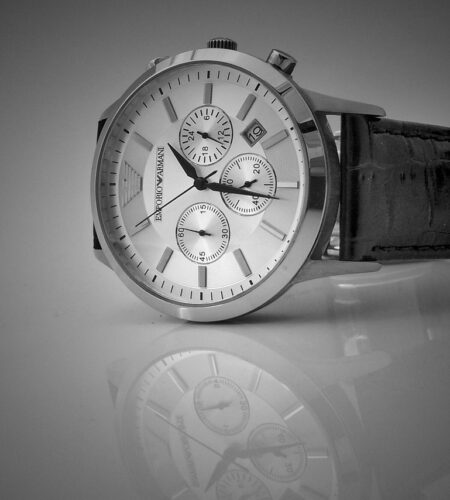
A watch that slips under a cuff makes dressing effortless; one that snags ruins the mood.
Buttoning a dress shirt, the sleeve snags the watch case and tugs the cuff — a repeating annoyance. Slim cases look dressier, but automatics, crystals and water resistance add height. The following gives realistic thickness targets and key variables that change whether a watch will clear a cuff: cuff style, fabric weight, fit, case diameter and lug-to-lug.
- <7 mm — excellent for tight French cuffs; almost guaranteed to clear.
- 7–9 mm — safe for most barrel cuffs and tailored shirts.
- 9–11 mm — borderline; may catch with heavy fabrics or tight cuffs.
Why thickness matters
The important dimension is the watch’s total height — crystal, case middle, and caseback combined. That stack determines whether a shirt cuff will glide over the top or sit against the case and start to move the watch.
How height creates problems
If the cuff sits on the case because the watch is taller than the fabric gap, three things happen: riding (the cuff pushes the case upward on the wrist), dragging (the cuff rubs along the strap or case), and catching (the cuff edge snags on lugs, a crown, or a pronounced bezel). Fabric stiffness, cuff fit, and sleeve length change when and how these occur.
The trade-offs, plainly
- Thin designs: slip under cuffs more easily, look dressier and feel lighter. Drawbacks: limited movement thickness, smaller power reserve, and lower ability to house robust water resistance or complicated layouts.
- Thick designs: allow automatic rotors, multi-layer dials, and stronger seals for diving. Drawbacks: greater chance of catching, a bulkier visual profile, and more wrist torque.
For regular shirt wear, prioritize a lower total height or choose features that reduce snagging: rounded casebacks, recessed crowns, and thinner straps to lower the effective stack.
Quick glossary: specs to watch for
- Thickness (case height)
Total distance from caseback to crystal — the spec that determines whether a watch will slide under a cuff; manufacturers sometimes list ‘height’ inconsistently.
- Lug-to-lug
Span between lug tips; affects how the case sits on the wrist and whether long cases protrude from cuffs.
- Case diameter
Across-the-dial measurement; larger diameters can make a thin case still catch cuffs due to edge exposure.
- Caseback profile
Flat or domed casebacks change wearing height; domed backs add perceived thickness and can lift edges into cuffs.
- Crystal height (domed vs flush)
How much the crystal rises above the bezel; high domes increase total thickness and are often omitted from brief specs.
A simple at‑home checklist to judge cuff clearance
-
Prepare the watch and shirt
Wear the watch on the strap or bracelet intended for dress use. Put on the dress shirt and fasten the cuff as normally worn (buttoned or with cufflinks).
-
Neutral wrist check
With the arm relaxed and palm facing the thigh, slide the wrist into the cuff. Note whether the case sits under the cuff edge, rubs it, or pushes the cuff up.
-
Movement checks
Rotate the palm up and down and bend the elbow slightly. If the cuff catches, binds, or lifts in any of these common positions, mark the watch as borderline or problematic.
-
Repeat with typical strap options
If a bracelet and a leather strap are both used, repeat the test with each. Bracelets often add height at the lugs and clasp that changes clearance.
-
Score the result
Classify as Clear (slips under cuff in all positions), Borderline (clears in neutral but catches in movement), or Snags (regularly prevents cuff closure or moves the cuff).
Test both single‑button and French cuffs if both are part of the wardrobe; cuff fit (tight vs loose) strongly changes outcomes.
Methodology: Tests used three common shirt fabrics—poplin (light), twill (medium), and oxford (thicker)—with single‑button and French cuffs, fitted to a trim sleeve. Watches were worn on standard leather straps and metal bracelets; observations recorded across neutral, supinated, and flexed wrist positions.
-
Shirts tested
Poplin, twill, oxford; single‑button and French cuffs.
-
Watch setup
Leather strap and metal bracelet configurations tested; normal daily tightness applied.
-
Positions observed
Neutral, palm up/down, and slight elbow bend.
Remember bracelets and cuff construction. A slim watch on a bulky bracelet can still catch; also account for stiff cuff interlinings and how tightly the cuff is buttoned.
Clear thresholds and an easy in‑store metric
Which details actually cause cuff catches
Thinness helps but is rarely the only factor; lug-to-lug length and how the case sits are often decisive.
A long lug span or a case that tilts the strap up can lift the case edge into the cuff even if overall height is low; see the rules for watch tightness with dress shirts for related fit cues.
Bevels reduce sharp catches but don’t eliminate bulk where lugs or spring-bar flanges protrude.
Edges help slide, yet a pronounced spring-bar flange or boxy lug will still catch fabric before beveling can help.
Strap construction often adds more stack than the case itself—padded leather, thick liners, and bulky buckles raise the watch.
A thin case on a thick padded strap can sit higher than a thicker case on a slim leather or mesh band.
Crowns, especially signed or onion crowns, can protrude and catch placket edges or cuffs.
Crown position and size matter more on tight cuffs; recessed or crown-guarded designs reduce this risk.
Perform a sleeve test on the actual shirt and strap combination before committing.
Check while the arm is bent and relaxed; posture changes clearance. Swap to a slim strap to see worst-case clearance. If unsure, prefer a slightly smaller lug-to-lug and recessed crown.Pre-purchase cuff-friendly checklist
-
Total thickness (real-world height)
Check the full height including crystal and caseback; under 7 mm is ideal, 7–9 mm usually slips under most cuffs, and over 11 mm often catches. Ask for an exact mm spec rather than a rounded claim.
Look forTotal thickness ≤9 mm (≤7 mm best)Avoid>11 mm total height -
Lugs, spring bars and strap profile
Prefer short, downward-curving lugs, low-profile spring bars and a tapered leather strap—these reduce effective bulk and keep edges from hooking the cuff.
Look forShort, swept lugs and tapered leather strapAvoidStraight long lugs and bulky metal bracelets -
Crown size and case edges
Small or recessed crowns and rounded, chamfered case sides lower snag risk; prominent crowns or sharp bezel lips protrude and catch more easily.
Look forRecessed/small crown and rounded edgesAvoidLarge protruding crown or sharp bezel ledges -
On-wrist test and online verification
In-store, slide the watch under a dress sleeve and move the wrist through the placket; online, request wrist-on photos, exact thickness shots, and confirm a flexible return policy.
Look forSleeve test or wrist-on photos + easy returnsAvoidNo sleeve test, unclear measurements, or strict no-return rules
How to measure crystal height when manufacturers omit it?
Use digital calipers to measure total thickness from caseback to crystal apex. If only case height is listed, subtract that number from total thickness. In shops, request a side profile photo with a ruler for verification.
Will swapping to a thinner strap reliably fix cuff catches?
A thinner strap often reduces lug-stack height and helps slippage, especially versus thick padded leather or bunds. However, lug geometry, spring bars and crown profile still dictate final clearance, so results vary.
Does higher water resistance always mean a thicker watch?
Higher water resistance frequently requires thicker cases, gasketed crystals or screw-down crowns, so greater mm is common. Engineering choices matter, and some designs achieve decent WR without excessive height.
Do domed crystals change cuff clearance much?
Domed crystals add perceptible height above published flat-crystal measurements; even a modest dome can add 1–2 mm. The curve profile matters more than the crown-to-case spec when judging slips under cuffs.
Are crystal replacements or mods a practical way to thin a watch?
Replacing with a thinner crystal is rarely practical; it can compromise water resistance and structural integrity and is often costly. Buying a purposefully thin model is usually a safer solution.
- Step 1 — classify the watch: measure total height (calipers or spec) and place into bands: <7mm, 7–9mm, 9–11mm, or >11mm. Also note crown size and crystal profile.
- Step 2 — run the quick shirt test: slide the watch under a dress‑shirt cuff or use stacked cards/coins as a surrogate. Mark clear, catches, or sticky fit.
- Step 3 — mitigate or select: if borderline, fit a thin leather/perlon strap, choose recessed crowns and flat crystals, or prefer a thinner alternative model; these moves commonly add 1–2mm clearance.
Threshold recap: <7mm ideal; 7–9mm safe; 9–11mm borderline; >11mm likely to catch. Common exceptions change the outcome: domed crystals, long or thick lugs, tall crowns, bulky spring bars, and heavy water‑resistance stacks can add millimeters and turn a ‘safe’ watch into a snag. Prioritize total height plus lug and crown profile over list thickness alone.
Short and sweet: 7mm under 7mm is ideal. My only complaint is the article could’ve included more pictures of the placket metric — a quick visual guide would be clutch.
Tried step 3 (the shirt test) and got a borderline result — clear sometimes, snags other times depending on the cuff fabric.
Is that just because of the strap thickness? My watch is 8.5mm but has a thick leather strap and slightly protruding spring bars.