

A swim is brief; salt left in a watch’s seams is not.
After an afternoon on a boat, salt crystals can linger around the crown, bezel, caseback, and strap joins long after the watch looks dry. Sand adds abrasion, dulling polished steel and working into rotating parts. Water resistance tells how well a sealed watch resists water pressure; it does not promise that every exterior material will age gracefully in brine.
For regular beach use, look beyond the depth rating: corrosion-resistant 316L steel or titanium, a sapphire or mineral crystal, and a rubber or resin strap make a more forgiving package. Ceramic bezels resist scratches well, while fabric and leather straps tend to hold salt and moisture. A fresh-water rinse and soft dry after each outing remains the simplest protection.
- Titanium is notably light and corrosion resistant.
- Resin straps avoid the salt-soaked feel of leather.


A Saltwater Watch Is Only as Strong as Its Weakest Part
-
Case and bezel
Titanium, marine-grade stainless steel, and quality resin cases are sensible starting points, but bezel action and inserts also need to resist trapped grit.
Look forA secure bezel with a durable insert and minimal exposed joints.AvoidJudging durability from case metal alone. -
Crystal and crown
Sapphire crystal shrugs off everyday scratches; a protected, smoothly threading screw-down crown helps keep saltwater out of the movement.
Look forSapphire and a well-guarded screw-down crown.AvoidA rough crown thread or an unprotected push-pull crown for regular swims. -
Bracelet or strap
Solid stainless bracelets, titanium, rubber, and silicone are easy to rinse. Fabric straps can hold salt and sand unless washed thoroughly.
Look forMaterials that drain and rinse clean at the lugs and clasp.AvoidLeather or absorbent straps for repeated sea use. -
Water resistance and serviceability
A meaningful water-resistance rating matters only when gaskets, crown seals, and caseback remain sound. Watch case materials explained offers useful context, but sealing completes the package.
Look forAt least 100 m resistance from a reputable maker, with available seal service.AvoidTreating an old rating as permanent protection.
After a beach day, fresh water should reach the crown guards, bezel edge, bracelet links, clasp, and strap holes. A watch that can be rinsed quickly and dried without hidden salt traps is often the better boat companion, even if another model has a more impressive case material.
Never operate the crown or pushers while the watch is wet. Rinse first, then dry it, and clean around moving parts gently.
A Depth Rating Is Not a Saltwater Guarantee
100 m is a sensible minimum for surface swimming and casual snorkeling when the watch is in good condition.
It is a laboratory pressure rating, not proof against salt corrosion. Before relying on it, understand how water resistance is tested: seals age, impacts matter, and hot water can stress them.
A 200 m rating adds practical margin for repeated swimming, snorkeling, spray, and more active water sports.
It does not make a watch maintenance-free. Salt can still collect around the crown, bezel, caseback, and strap fittings.
A secured crown improves the seal only when it is fully screwed or pushed in, depending on the design.
Never operate the crown in water. Check that it is closed before swimming, then rinse the watch gently with fresh water afterward.
Why 316L steel is the easy default
For most beach, pool, and boat days, 316L stainless steel is the sensible place to start. It has strong everyday resistance to corrosion, takes the occasional knock well, and is used widely enough that replacement straps, spring bars, and servicing are rarely exotic problems. It is not immune to salt left sitting in crevices, so a fresh-water rinse still matters.
The useful question is not whether a listing says “marine-grade” or “surgical steel,” but whether it clearly confirms a 316L case and pairs it with sound construction. Look for:
- a screw-down crown and caseback where appropriate for the stated water rating
- a well-fitted bezel, crystal, and crown with no obvious looseness
- solid lugs and, on a bracelet, solid end links rather than folded hollow pieces
- a stated water-resistance rating from the maker, not a vague “waterproof” claim
A brushed or satin finish is especially practical near sand, dock hardware, and boat rails. Fine scuffs blend into its grain; a mirror-polished case shows each new mark far more readily. Polished accents can still look smart, but an all-brushed tool-watch finish is easier to live with.
More expensive steel grades can be worthwhile, yet they should not outweigh proven seals, a clear specification, and careful finishing. A properly built 316L watch with a sapphire crystal and a rinsed, drained strap is usually a better coastal companion than a poorly documented “premium” alloy.
316L case with travel-friendly GMT
This 39.5 mm model lists a 316L steel case, sapphire crystal, ceramic bezel, and 10 ATM water resistance. Its NH34 movement adds an independently adjustable local hour hand, while the supplied rubber strap avoids the trapped moisture of many leather options. The stated rating suits casual swimming when the crown is secured; saltwater should still be rinsed off afterward.
Titanium keeps the weight down
Titanium is the case material that tends to disappear on the wrist. It is markedly lighter than steel, which is welcome when a watch stays on through swimming, sailing, hiking, and humid afternoons. It also has excellent natural resistance to saltwater corrosion, so a sound titanium case is a reassuring long-term choice.
That does not mean titanium stays pristine. Many grades show surface scuffs and rub marks more readily than brushed 316L steel, and their darker gray tone can make those marks noticeable at certain angles. The marks are usually cosmetic rather than corrosion, but anyone wanting a crisp, new-looking watch should prefer a brushed finish or accept the lived-in look.
A hardened coating or surface treatment can make a meaningful difference. It is worth checking whether the maker specifies one; vague “scratch-resistant” language is less useful than a named hardening process. For a practical comparison of titanium and steel on boat and beach days, weight and finish preference often matter more than theoretical corrosion resistance.
As with steel, fresh-water rinsing after salt exposure still protects the crown, bezel gap, and strap hardware.
Solar-powered, 300 m-rated option
At roughly $100, the Triton-TI pairs a titanium case with solar quartz power and a 300 m water-resistance rating. Luminous hands and markers suit low-light water use. Its mineral glass is a sensible value-minded choice, but it is more vulnerable to scratching than sapphire—worth remembering on rocky trips or around boat hardware.
Resin and rubber for carefree water days
For surfing, fishing, paddle sports, and travel, resin cases and polymer straps are often the least fussy option. They cannot rust, weigh very little, and are comfortable when a watch stays wet for hours. A scuff on molded resin also tends to be less upsetting than one on polished steel or titanium.
Quality rubber straps are particularly useful around water because they do not absorb water like leather or fabric. Look for a soft, flexible strap with solid buckle hardware and enough holes to avoid a loose fit over a wetsuit. After a saltwater session, rinse the case, buckle, and strap underside in fresh water, then dry them out of direct sun.
The trade-offs appear over time:
- UV exposure can fade, stiffen, or eventually crack resin and rubber.
- Sunscreen, sweat, and trapped moisture can leave a rubber strap smelly if it is never cleaned.
- Straps are consumable parts; replacing one after a few hard seasons is normal rather than a watch failure.
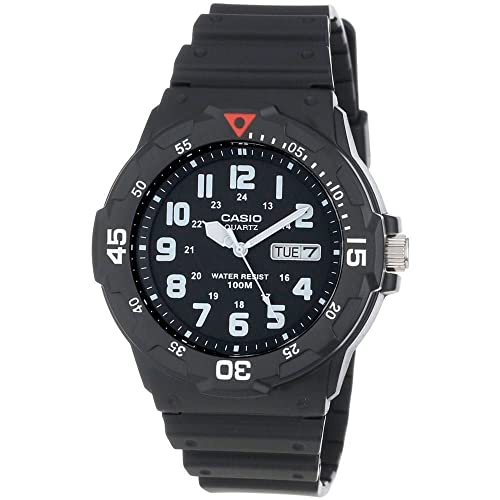
The Casio MRW200H-1BV is a practical example: its 43 mm resin case and molded resin band avoid metal-corrosion worries, while its 100 m rating is intended for swimming, snorkeling, sailing, and recreational water sports. Its rotating bezel and day-date display also suit casual boat or shore use. As with any 100 m watch, its crown should stay fully closed before entering the water.
Ceramic and sapphire earn their place
Ceramic bezels and case components are unusually good at staying tidy through ordinary beach use. Fine sand, sunscreen residue, and the constant brushing against bags or deck hardware tend to leave far fewer visible marks than on polished steel or titanium. A ceramic bezel insert also will not corrode, and its color is generally stable in strong sun.
That durability has a limit: ceramic is hard, not indestructible. It resists scratching exceptionally well, but a sharp blow against a rock, metal cleat, or tile edge can chip or crack it. For rough sailing, diving work, or situations where hard impacts are likely, a steel or titanium bezel may collect scratches yet remain the more forgiving choice. This differs from the way bronze changes in marine conditions, where a visible patina is part of the material’s character rather than damage.
Sapphire crystal is the practical priority
For the watch face, sapphire crystal is one of the most useful upgrades available. It handles the daily abrasion that puts faint swirls into mineral crystal: sandy fingertips, dried salt wiped away too quickly, and a watch laid face-down on a table. A clear sapphire crystal keeps a beach watch readable long after a softer crystal may look hazy.
A few checks still matter:
- Look for anti-reflective coating, ideally on the underside, to reduce glare without leaving an outer coating exposed to wear.
- Rinse sunscreen and salt from the crystal and bezel gap with fresh water after swimming.
- Treat sapphire as scratch-resistant, not impact-proof; a hard edge can still crack it.
Ceramic and sapphire do not replace sound sealing or a corrosion-resistant case, but they are high-value additions for a watch expected to look presentable after many shoreline trips.
Bronze rewards those who like change
Bronze is not chosen for a permanently pristine finish. In salt air and water, its copper-rich alloy gradually darkens and can develop brown, green, or nearly black areas. That living patina gives a watch a convincingly nautical, individual character—especially on a brushed case.
The change is rarely even. Moisture caught under a bezel, around the crown, or against the caseback can create blotches, and a fresh patina may leave a faint green or dark residue on skin or cuffs. This is usually cosmetic, but it can be unwelcome for sensitive skin.
Bronze suits an owner happy to let the case age rather than fight it. Fresh-water rinsing and thorough drying still matter; cleaning can slow or remove patina, but it also resets the look that makes bronze appealing.
Be skeptical of coatings
Frequent ocean use is a poor match for gold-tone plating, black fashion finishes, or any case described only as “alloy.” Once a thin decorative layer wears through at edges, lugs, or the clasp, saltwater can reach the base metal; discoloration, pitting, and peeling may follow.
A named, documented treatment is different. Coated watches built to resist saltwater wear should identify both the base metal and process, such as hard DLC or a specified PVD system—not merely promise a “coated” look. Even tough treatments can be scratched through, so a solid corrosion-resistant case is the safer foundation. Skip listings that cannot say what lies beneath the finish.
The clasp, caseback, and lug edges often reveal coating failure before broad case sides. Bare metal showing through is a warning sign.
Match the watch to the trip
For mixed travel—flights, pool time, dinners, and a few beach swims—316L steel with sapphire remains the low-drama choice. A rubber strap makes rinsing simpler, while a steel bracelet works well when its extra cleaning is not a concern.
For long, active days
Titanium or a resin-cased watch reduces wrist fatigue during hikes, paddling, and hot-weather wear. Pair either with rubber or a washable synthetic strap; both dry quickly and tolerate frequent fresh-water rinses.
For surfing and regular water sports
A resin or steel watch on rubber is usually the most practical setup. Rubber has no links, fabric layers, or hidden seams to retain salt. Bracelets are durable, but salt and grit can linger between links and around the clasp, so they need a more deliberate rinse and occasional gentle brushing.
For particular tastes
Scratch-conscious owners may prefer ceramic with sapphire, accepting that a hard knock can chip ceramic. Those who enjoy a changing, lived-in finish can choose bronze. Leather, however, is a poor match for repeated seawater exposure: it absorbs salt, dries stiff, and deteriorates far faster than rubber or synthetic alternatives.
Treat the rinse as part of the swim
-
Before entering
Close and screw down the crown; check strap pins and bezel.
-
Keep controls shut
Never operate crown or pushers underwater.
-
Rinse immediately
Flush case, bezel, bracelet gaps, and buckle with fresh water.
-
Dry and inspect
Pat dry; air-dry straps and look for trapped grit.
Do this after every swim, not at the end of the trip.
Saltwater can enter through an open or poorly seated crown. Set the time on shore, then confirm it is fully pushed or screwed home.
Choosing a case material
Chrono24 compares common watch-case materials, including bronze, to help weigh finish, weight, and wear around saltwater.
Pick durability before novelty
- Choose bronze, ceramic, or coated finishes only for a specific preference—not as a saltwater upgrade.
For most beach and boat use, a properly water-rated 316L steel or titanium watch on a rubber strap is the low-drama choice: corrosion resistance, easy rinsing, and no bracelet crevices to fuss over. Titanium suits long active days; steel offers reassuring toughness and easy refinishing.
Ceramic, bronze, resin, and coatings can be excellent when scratch resistance, patina, low cost, or a particular look matters most. Whatever the material, a closed crown and a fresh-water rinse after swimming remain non-negotiable.
I have a titanium watch and love the weight, but the little scratches are very noticeable in certain light.
Would a hardened coating be a concern at the coast if it eventually gets scratched through? It seems like coatings are being sold as a miracle solution lately, which makes me suspicious.
Good practical article. I was initially shopping by “marine-grade” buzzwords, but the point about the weakest component makes much more sense.
For a week-long coastal vacation, would you choose 316L on rubber over a steel bracelet even if the bracelet itself is good quality? I can rinse either one, but I’d rather not spend ten minutes flushing salt out of every link every evening.