

A bright, data-forward running watch — great for serious athletes, but expect tradeoffs in battery life and complexity.
Don’t let a dim screen or flaky GPS ruin your training. Serious runners need a clear display, accurate metrics and actionable recovery data — not just step counts. The Garmin Forerunner 265 answers that need with a colorful AMOLED touchscreen (plus button controls), advanced training readiness and HRV morning reports to help you plan smarter runs.
The 46 mm lightweight case houses accurate multi-band GPS and wrist-based running power, making it useful for long runs and multisport activities. Expect stellar visuals and deep insights, but also a shorter battery life if you use always-on display or music, and a steeper learning curve for the advanced metrics.
Garmin Forerunner 265 AMOLED Running Smartwatch
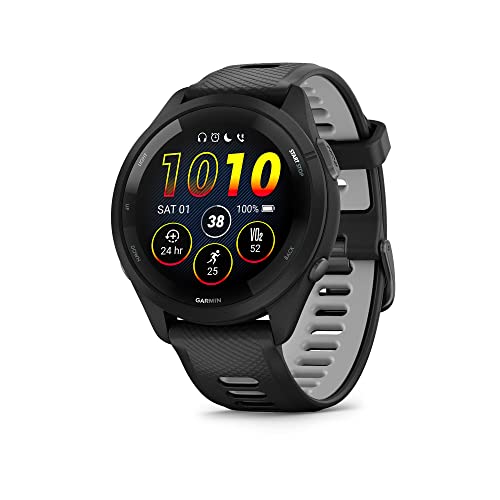
This watch blends a vivid AMOLED display with robust training and recovery tools, offering serious runners a well-rounded mix of metrics and usability. Battery life is strong for its class but will be shorter if you use always-on display and music frequently.
Garmin Forerunner 265 In-Depth Review: AMOLED Touchscreen
Overview
The Garmin Forerunner 265 brings premium display technology and a focused training toolset to the dedicated runner who also wants a capable everyday smartwatch. It pairs a bright, colorful AMOLED touchscreen with Garmin’s mature run coaching ecosystem: adaptive workouts, race planning, HRV-based morning reports and wrist-based running power. The result is a device designed to help you understand not just each workout, but how prepared your body is for the next one.
Design and Display
The 46 mm case is lightweight and low-profile for long sessions, and Garmin keeps physical button controls alongside the touchscreen so you can use it in any weather or while wearing gloves. The AMOLED panel is a standout feature — text, maps and metrics appear crisp and vivid, with customizable watch faces that actually look premium rather than utilitarian.


Key physical and display highlights:
Performance, GPS and Sensors
This model uses multi-band GPS and a suite of sensors (optical heart rate, accelerometer, compass, gyroscope) to deliver accurate route tracking and metrics. Multi-band GPS helps reduce drift in urban canyons and under tree cover, while the refined optical HR sensor provides reliable heart rate trends for most activities.
Common performance outcomes you can expect:
Battery Life & Charging
Battery life is competitive for a watch with an AMOLED display, but actual runtimes vary widely depending on settings and usage. If you use the always-on display, music and frequent GPS workouts, expect shorter intervals between charges. In typical mixed use (notifications, several runs per week, AMOLED active but not always-on) the watch comfortably lasts multiple days.
Battery modes and typical estimates:
| Mode | Estimated Runtime |
|---|---|
| Smartwatch mode (typical use) | Up to ~10–13 days depending on settings |
| GPS mode (continuous multi-band) | Up to ~20 hours |
| GPS + music | Reduced; plan for significantly less than GPS-only |
Training Features and Recovery Insights
Where the Forerunner 265 truly earns its place is in the training ecosystem. It’s designed to guide you from daily workouts to race day with metrics that reflect both performance and readiness.
Notable training and recovery features:
These features are most useful when you consistently sync sessions to Garmin Connect. Over time the system learns patterns and refines suggested workouts and recovery guidance.


Software, Connectivity and App Experience
Garmin’s interface on the watch is straightforward; a combination of swipes, taps and buttons makes it flexible for quick checks or intense workouts. Most serious users will spend time in Garmin Connect — the mobile and web dashboards give deep post-workout analysis and allow you to plan training cycles, download structured workouts, and sync third-party platforms (Strava, TrainingPeaks).
Connectivity highlights:
Who Should Buy This
If you’re a committed runner who wants more than basic distance and pace — someone who values recovery, HRV insight, and adaptive race planning — this watch is a strong fit. It’s also a good option for multisport athletes who appreciate accurate GPS and the option to switch to cycling, swimming and triathlon modes.
Consider alternatives if you:
Practical Tips and Accessories
Small choices can improve the daily experience and extend the watch’s life:
Final Thoughts
The Forerunner 265 occupies a sweet spot: it gives you a premium display and the advanced metrics you need to train intelligently, along with the dependable GPS tracking expected from Garmin. It’s not a budget pick, and advanced features may require a learning period, but for runners aiming to improve performance while monitoring recovery and day-to-day readiness, it’s one of the best-balanced options available.
FAQs
Yes. The Forerunner 265’s AMOLED panel is bright and offers strong contrast, making it readable outdoors. In direct sunlight you may need to increase brightness or use the high-contrast watch face, but for most daytime runs the display remains clear.
The watch uses multi-band GPS, which improves accuracy compared to single-band receivers—especially in areas with tall buildings or tree cover. For the tightest accuracy on treadmill runs or pace drills, pairing a footpod or cadence sensor can help refine instant pace and cadence readings.
The morning HRV (heart rate variability) report provides an estimate of nervous system recovery and stress. It’s not diagnostic, but it helps indicate whether you’re rested or if a hard session could be counterproductive. Use it in combination with sleep quality and subjective feelings rather than as a sole decision maker.
Yes. The Forerunner 265 supports multiple activity profiles including triathlon, which lets you transition between swim, bike and run activities with a single session. However, if you race elite-distance triathlons frequently, you may want to check swim open-water tracking behavior to ensure it meets your needs.
To extend runtime, disable the always-on display, turn off music and notifications, and use battery saver GPS settings if you can accept slightly reduced location update frequency. Carrying a compact power bank for quick top-ups is a practical option for ultra-distance events.
Wrist-based running power provides immediate effort feedback without extra devices and is valuable for pacing. It won’t perfectly match a dedicated running power pod in every condition, but it’s convenient and consistent for pacing strategy and perceived effort when used over time.
The Forerunner 265 supports music storage and playback with compatible streaming services via phone integration. Check Garmin’s current list of supported services for offline download options—streaming features often depend on app partnerships and regional availability.
Absolutely. With notifications, customizable watch faces, daily health tracking (sleep, stress, Body Battery) and a stylish AMOLED screen, it functions very well as an everyday smartwatch while still offering deep athletic features when you train.
Bought this as a gift and i’m still learning the features — the training plans are surprisingly deep, but setting up custom workouts felt a bit clunky at first. Also, the gps route import had a weird offset (maybe my route file?).
Not a dealbreaker, just some teething issues. Otherwise looks great and the screen is 🤌
For custom workouts I found building them in Garmin Connect on desktop way easier than on the watch.
Good call, I’ll check the coordinate system. TY!
Route offset can happen if the GPS take a moment to lock before starting. Make sure the watch has a strong satellite fix before you begin, and try re-importing the GPX if it persists.
When I had offset issues it was my GPX coordinate format — exporting in WGS84 fixed it for me.
Anyone tried the music feature? I mostly stream from my phone so I don’t care much about onboard storage, but curious if the watch handles Bluetooth earbuds well.
FYI: music playback does reduce battery noticeably, especially if you’re also using GPS and the always-on screen.
I tested with AirPods and some generic Bluetooth earbuds. Connection was stable, but I prefer carrying my phone to use playlists I don’t want to transfer to the watch.
The 8 GB storage is handy if you want offline playlists, though that will limit space for maps or other files. For most users who stream, the watch acts as a controller without needing much local storage.
Good to know. Might try transferring a few playlists to test battery impact.
I upgraded from my old Forerunner 245 and the display on the 265 is genuinely a step up.
Colors are vivid and the watch faces look modern.
Battery life is decent — lasted me through a weekend of runs with some GPS and music tests.
Only gripe is the always-on mode drains it much faster than Garmin advertises.
Still, for $299.99 I’m pretty happy with the overall package.
Thanks for the comparison, Emily. Good point about always-on display — we noted that in testing too. If you primarily run with GPS and notifications but skip music, you’ll find the battery holds up well.
Touch is much better, Marcus. Feels less laggy, and the AMOLED makes swiping through widgets satisfying. 🙂
I did the same jump from a 245! How’s the touch response? I found the menus snappier on the 265.
Quick question: does the 265 sync well with third-party apps like Strava and TrainingPeaks? I’m considering buying but need smooth data export.
I use Strava and it’s been seamless for me. The only annoyance is that heart-rate smoothing feels different once exported, but that’s a common sync quirk, not specific to the 265.
One tip: if you want rawer HR data on Strava, export the FIT file from Garmin Connect and upload that directly — that preserves the original metrics.
Make sure auto-sync is on in the mobile app. Took me a minute to find it lol.
Great tip, thanks! I’ll try the direct FIT upload if I notice discrepancies.
Yes — Garmin Connect acts as the bridge. Workouts upload to Connect and can be auto-synced to Strava/TrainingPeaks if you enable the integrations. We didn’t see issues with missing data in our tests.
I love that Garmin put AMOLED on a Forerunner but tbh I miss the days when watches were simple and didn’t nag you about recovery every 5 minutes. 😂
Ha — the coaching features are a double-edged sword. They help a lot for structured training, but if you prefer minimalism you can turn off many of the notifications and metrics.
You can mute recovery alerts and configure which health prompts appear. I turned off the ones I found intrusive and kept the essentials.
I like the recovery insights — they helped me not overdo intervals last month. Curious if anyone else noticed the VO2 max estimates feel a bit conservative compared to treadmill lab results.
Same here. Mine was lower than a lab test, but it tracked improvements reliably after I changed my training plan.
Good observation. Lab VO2 max tests are more precise; Garmin’s estimates are useful for trends rather than absolute values. Use them to compare progress over weeks and months.
Bought one during a sale — love the watch face artwork and AMOLED colors. The training metrics are impressive for the price range. 👍
The interface is mostly intuitive but I got a little lost in advanced settings at first.
Would recommend for intermediate runners who want more than basics.
A few small UX nits, but nothing a firmware update couldn’t fix.
Worth the $299.99 deal I found on Amazon.
Glad you like it, Priya. We’re seeing Garmin roll out firmware updates that tidy up menus and add features — those UX complaints often improve over time.
Which sale did you catch? Been watching prices for a while and might jump on it.
Reminder: if you buy from a third-party seller, confirm warranty coverage. Amazon-sold units generally include standard Garmin warranty.
Also check refurbished options from Garmin sometimes — can save a good chunk.
Amazon had a limited-time discount a couple of weeks ago. Keep an eye on holiday deals and Prime Day if it comes up.
Solid watch overall. A few things I noticed after a month of daily wear:
– The AMOLED is gorgeous in daylight and bright indoor lighting.
– Sleep tracking is pretty accurate compared to how I feel in the morning.
– GPS is reliable, though I did see one glitch during heavy tree cover.
– The strap is comfy but I swapped it for a softer band for long runs.
Any other strap recs from folks here?
Thanks for the detailed rundown, Hannah. Many users switch to silicone or woven nylon for longer runs — both are comfortable, the nylon breathes better though it can absorb sweat.
Thanks! I’ll try a woven nylon next. Prefer breathable for summer runs.
I like silicone sport bands from third-party makers — cheap and durable. Just make sure the lug width matches the 265’s connectors.
I’m torn between the 265 and a cheaper wearable. The training tools seem worth it, but I worry about battery longevity if I actually use all the features. Any battery-life real-world numbers?
In our testing, expect multiple days (typically 4–7) with regular use. Heavy GPS+music+always-on display will shorten that significantly. If battery is your top priority, consider disabling always-on and limiting music stored on the watch.
I get about 5 days with moderate use (daily runs, notifications, occasional music). Your mileage may vary though.